What Are Biweekly Payments?
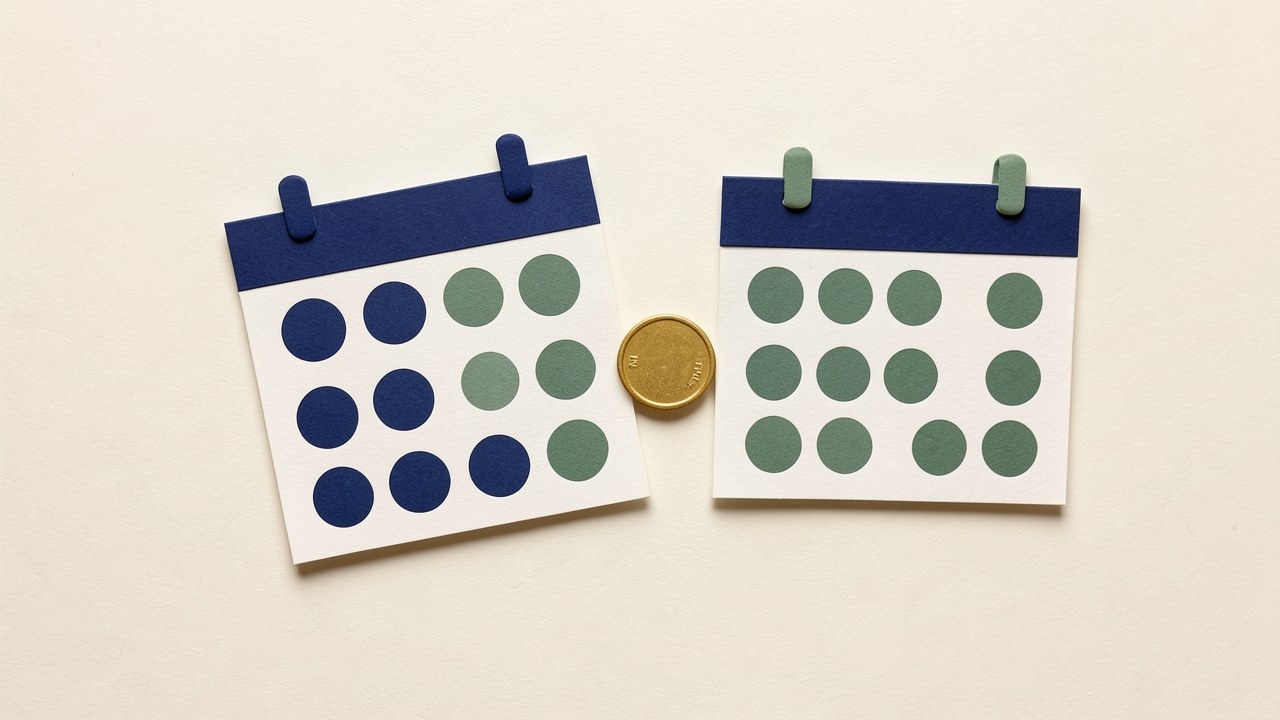
With a traditional monthly payment plan, you make one payment every month, usually for a fixed amount. A biweekly payment plan splits that same monthly amount in half and schedules a payment every two weeks. Because there are 52 weeks in a year, you end up making 26 half-payments, which equals 13 full monthly payments over 12 months.
That extra payment each year is the core of the strategy. By making one additional monthly-equivalent payment annually, you reduce the loan's principal balance faster than you would with a regular monthly schedule. This lowers the total interest you pay and can shorten the time it takes to pay off the loan.
- Biweekly payments are not the same as twice-monthly payments. Biweekly means every two weeks (26 payments per year); twice-monthly usually means on the 1st and 15th, producing 24 payments per year.
- The benefit comes from the extra full payment applied to principal each year, not from the frequency alone.
How Biweekly Payments Reduce Interest
Interest on most loans is calculated based on the outstanding principal balance. When you make a payment, a portion goes toward interest and the rest reduces the principal. By paying more frequently and making that extra annual payment, you lower the principal faster. A smaller principal balance accrues less interest over time, so the total interest cost drops.
The effect is most noticeable on longer-term loans with higher interest rates, such as auto loans and mortgages. Even a small reduction in the principal early in the loan can compound into meaningful savings over the life of the loan.
- Every extra dollar applied to principal reduces future interest charges.
- The savings depend on the loan amount, interest rate, and remaining term.
Step-by-Step: Setting Up Biweekly Payments
Once you understand the potential savings, the next step is to decide how to implement the plan. The method you choose depends on your lender and your comfort with managing payments manually.
- Check with your lender to see if they offer a biweekly payment option directly. Some lenders allow you to set up automatic biweekly withdrawals without fees.
- If your lender does not offer a biweekly plan, ask if they accept additional principal payments without penalty. Many lenders allow you to make extra payments at any time.
- Estimate your payment amount. Take your usual monthly payment, divide by two, and that becomes your biweekly amount. For example, a $400 monthly payment becomes $200 every two weeks.
- Choose a payment method: schedule automatic transfers from your bank account to your lender on a biweekly cycle, or manually make an extra principal payment once a year when you have accumulated the equivalent of one monthly payment.
- Specify that the extra payment be applied to the principal, not to future interest. You may need to write 'apply to principal' on your check or request it in your online payment instructions.
- Keep records of your payments and monitor your loan balance to confirm the principal is being reduced as intended.
Example: $20,000 Auto Loan Comparison
The savings from biweekly payments can be significant, but the exact numbers depend on your loan terms. Here is a realistic example using a $20,000 auto loan at 5.5% APR for 60 months. The monthly payment is calculated using the standard amortization formula. The biweekly plan splits the monthly amount in half and makes 26 payments per year, with the extra payment applied to principal.
As the table below shows, switching to biweekly payments saves about $529 in interest and shortens the loan term by about 5 months. In this example, the biweekly payment is half of the standard monthly payment: $382.02 / 2 = $191.01.
This example uses a fixed interest rate and assumes no late fees or prepayment penalties. Actual results vary by lender and loan terms.
- Monthly payment: $382.02
- Biweekly payment: $191.01 (half of the monthly amount)
- Interest savings: $529.30
- Term reduction: 5 months
| Plan | Payment Amount | Total Interest Paid | Loan Term | Total Paid |
|---|---|---|---|---|
| Monthly payments | $382.02 | $2,921.20 | 60 months | $22,921.20 |
| Biweekly payments | $191.01 | $2,391.90 | 55 months | $22,391.90 |
Potential fees and cautions
Not all biweekly payment programs are free. Some third-party companies offer to set up biweekly payments for a fee, often charging an enrollment fee or a per-payment fee. The savings from interest may be offset by these costs, so it is important to compare the total cost of the service against the potential savings.
Also, check your loan agreement for prepayment penalties. While many loans do not charge penalties for paying off early, some do. If your loan has a prepayment penalty, the savings from biweekly payments could be reduced or eliminated.
Finally, be cautious about payment timing. If you schedule biweekly payments, ensure you have enough funds in your account to avoid overdraft fees. Late payments can harm your credit score and may incur late fees.
- Ask your lender about fees before signing up for a biweekly program.
- Read your loan contract for prepayment penalty clauses.
- Set up automatic payments only if you can comfortably cover each payment.
Alternatives to Biweekly Payments
Biweekly payments are not the only way to accelerate your loan payoff. Consider these alternatives if biweekly payments do not fit your cash flow or budget:
- Make one extra monthly payment per year as a lump sum, either annually or divided into smaller amounts.
- Round up your monthly payment to the nearest $50 or $100 and apply the extra amount to principal.
- Refinance to a shorter term or a lower interest rate, if you qualify.
- Use a windfall, such as a tax refund or bonus, to make a lump-sum principal payment.
Frequently asked questions
Do biweekly payments really shorten my loan term?
Yes, biweekly payments can shorten your loan term when they result in an extra full payment applied to principal each year. The exact amount of time saved depends on your loan amount, interest rate, and term length. In the illustrative auto loan example above, the loan term was reduced by about 5 months.
Can I set up biweekly payments with any lender?
Not automatically. Some lenders offer biweekly payment options directly, while others do not. If your lender does not offer the option, you can still achieve a similar effect by making an extra principal payment once a year. Always ask your lender about their policies and any fees involved before signing up for a biweekly plan.