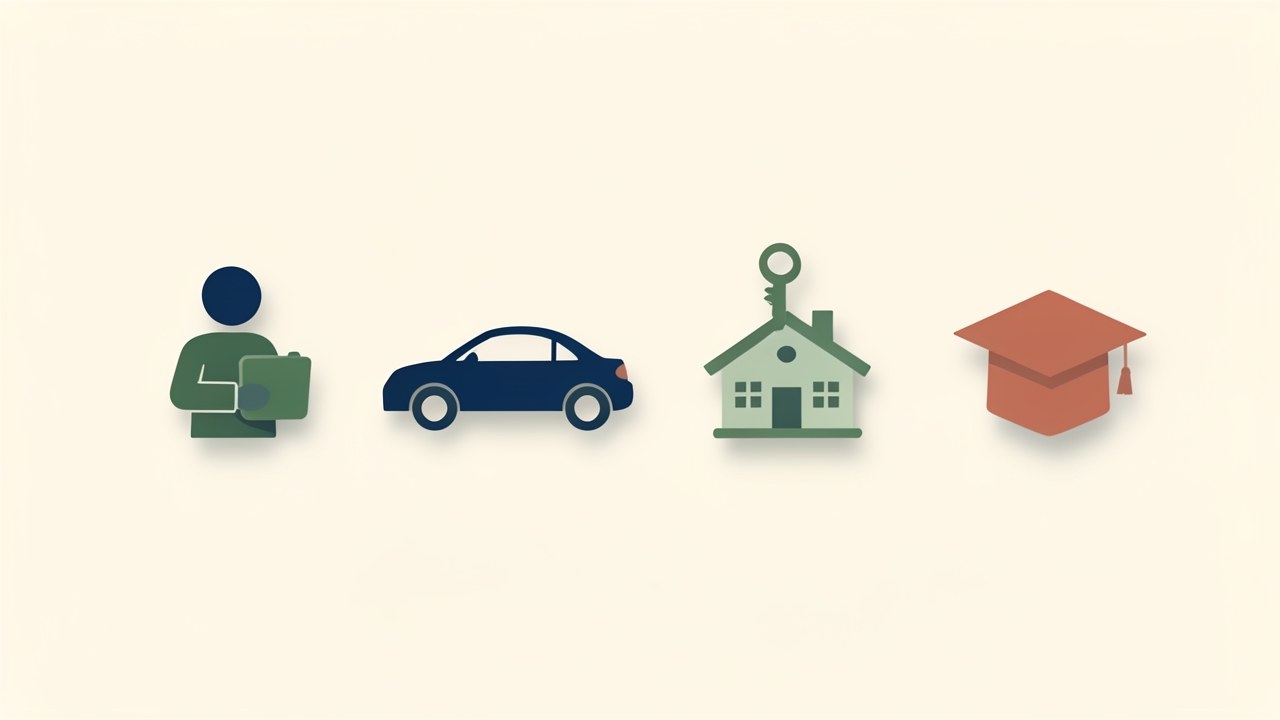
Introduction to Loan Types
Loans come in many shapes and sizes, but they all share a common core: you borrow a principal amount and repay it over time with interest. The way that repayment is structured—how often you pay, how the interest is calculated, and what costs are bundled into the payment—can vary significantly from one loan type to another.
Knowing which type of loan you have or are considering helps you understand the payment formula that applies and what factors (like interest rate, term, and fees) will have the biggest impact on your monthly obligation.
Personal Loans: Features and Calculation
Personal loans are typically unsecured installment loans, meaning they are not backed by collateral like a house or car. Lenders decide your interest rate based on your creditworthiness, and you repay the loan in fixed monthly payments over a set term, commonly 24 to 84 months.
The payment for a fixed-rate personal loan is calculated using the standard amortization formula, which spreads the principal and interest evenly across the loan term. Because the rate and term are fixed, the monthly payment stays the same for the life of the loan.
- Interest rates for personal loans can be higher than secured loans because the lender has no collateral to recover if you default.
- Common uses include debt consolidation, home improvements, or unexpected expenses.
- Some personal loans may have origination fees, which are not included in the interest rate but affect the annual percentage rate (APR).
Auto Loans: Terms and Payment Variations
Auto loans are usually secured by the vehicle itself, which reduces risk for the lender and typically results in lower rates than unsecured personal loans. Loan terms commonly range from 36 to 72 months, though longer terms are sometimes available.
Like personal loans, auto loans are generally amortized with fixed monthly payments. The calculation uses the same formula, but the loan amount, interest rate, and term determine the exact payment. A longer term lowers the monthly payment but increases total interest paid over time.
- The vehicle serves as collateral, so failure to repay can result in repossession.
- Rates on new and used cars can differ, as can rates for financing through a dealership versus a bank or credit union.
- Down payment and trade-in value reduce the amount financed, which directly influences the monthly payment.
Mortgages: Amortization and PMI
Mortgages are long-term secured loans used to buy real estate. Most are amortized over 15 or 30 years, meaning your monthly payment includes a portion of principal and interest. Because of the long term, the interest portion dominates the early payments, with the principal share growing over time.
A key variation in mortgage payment calculations is private mortgage insurance (PMI). If your down payment is less than 20% of the home's purchase price, lenders typically require PMI. PMI is an extra cost added to your monthly payment, but it is not part of the loan's interest rate; it's a separate insurance premium that protects the lender.
Property taxes and homeowners insurance are often escrowed into the monthly payment, so the total payment includes these additional amounts on top of principal and interest. This means the monthly payment is higher than the principal-and-interest-only amount.
- Fixed-rate mortgages have a constant interest rate and payment for the entire term.
- Adjustable-rate mortgages (ARMs) have an interest rate that can change after an initial fixed period, which alters the payment calculation.
- PMI is typically removed once you have built at least 20% equity in the home, either through payments or appreciation.
Student Loans: Deferment and Forbearance
Student loans are used to pay for higher education and can be issued by federal or private lenders. Federal student loans offer a variety of repayment plans, including income-driven options, while private loans generally have fixed or variable rates with set terms.
One unique aspect of student loans is the option for deferment and forbearance, which allow you to temporarily pause or reduce your payments under qualifying circumstances. During deferment, interest usually does not accrue on subsidized federal loans, but it does accrue on unsubsidized loans and most private loans. Forbearance always accrues interest, and that unpaid interest may be capitalized—added to your principal balance—which increases the amount you owe and affects future payment calculations.
- Federal loans may offer income-driven repayment plans that recalculate your payment based on income and family size.
- Deferment is often available for enrollment in school, unemployment, or economic hardship, while forbearance is typically for shorter-term financial difficulties.
- Capitalized interest can significantly increase the total cost of the loan, since you pay interest on the added principal.
How Interest Rates Vary by Loan Type
Interest rates are not uniform across loan types. Because secured loans present less risk to lenders, they generally come with lower rates—as seen with mortgages and auto loans. Unsecured loans like personal loans carry higher rates to compensate for the added risk. Student loans fall in between, with federal rates set by law and private rates depending on creditworthiness.
The exact rate you receive on any loan depends on factors such as your credit score, debt-to-income ratio, loan amount, and term. Shopping around and comparing offers remains the most reliable way to find the best rate for your situation.
Choosing the Right Loan Type
The best loan type for you depends on your purpose, your ability to provide collateral, and how long you need to repay. For example, if you have equity in a home, a home equity loan might offer a lower rate than a personal loan, but it puts your home at risk. If you need a car, auto financing is built for that purchase, often with competitive rates.
Always consider both the monthly payment and the total cost over the loan term. A longer repayment period may lower your monthly payment but increase total interest. Review the annual percentage rate, which includes certain fees, to compare loans more accurately than the nominal rate alone.
- Assess whether you can offer collateral and what risk that entails.
- Compare not only the interest rate but also any upfront fees, prepayment penalties, and insurance premiums.
- Use a loan payment calculator with your specific rate, term, and amount to estimate the monthly payment and total interest.
Frequently asked questions
What is the difference between secured and unsecured loans?
A secured loan is backed by collateral—an asset the lender can seize if you default, such as a house or car. Mortgages and auto loans are common examples. An unsecured loan does not require collateral, so the lender has no direct claim on your property; personal loans and most student loans fall into this category. Because unsecured loans present more risk to the lender, they typically carry higher interest rates.
Do all loans use the same payment formula?
Most fixed-rate amortized loans, such as personal, auto, and standard mortgages, use the same underlying formula to calculate a level monthly payment. However, not all loans fit this pattern. Adjustable-rate mortgages change their rate over time, income-driven student loans recalculate payments based on income, and some loans may have interest-only periods or balloon payments. Additionally, costs like mortgage insurance or property taxes can be added to your monthly payment, so the total amount you pay can differ from the pure principal-and-interest calculation.